The
Cloning of Barbie
By Gene Lutz
It’s a well-kept
secret. Few people know that Barbie the most popular toy in the world
has, according to Mattel, a first and last name, parents, and an astrological
sign. Less well known even than these obscure facts is that Barbie is,
in reality, a clone! She was copied from Lilli, a doll fashioned in 1955
after a cartoon character in the West German newsletter Bild, arriving
on the American market in 1959 as a fully fashioned 11½-inch grown
up beauty.
 Skipper,
1975, with long blonde hair. Her bustline increases or decreases
as her left arm is moved backward or forward. Skipper,
1975, with long blonde hair. Her bustline increases or decreases
as her left arm is moved backward or forward.
Some 351,000 Barbies
were sold in that first year. The real money-spinner, though, was Barbie’s
wardrobe full of fashion clothes and accessories – sold separately. Sell
one doll but an infinite change of clothing. Selling 150 new varieties
of Barbie each year, plus friends, on a worldwide market achieved a sales
record of two dolls per second. Multiply that figure by the number of fashion
items for each doll – mind-boggling, isn’t it?
It was a serendipitous
meeting when Ruth Handler, founder of Mattel, mother of Barbie, saw Lilli
in the window of a toy shop in Lucerne, Switzerland. Lilli was 11½
inches tall. So is Barbie. What a coincidence. Lilli was a shapely blonde
of rigid plastic. So was the first Barbie. Another coincidence?
 Barbie
American Girl with ash blonde hair before bendable knees were introduced. Barbie
American Girl with ash blonde hair before bendable knees were introduced.
When Mattel acquired
the patent and legal rights, the cloning of Barbie began. Named after Handler’s
daughter, Barbie officially debuted at The New York Toy Fair in 1959. The
introduction of a petite plaything caused a sensation as the American market
at that time was flooded with "bigger is better" life-size dolls. Three-foot
pseudo sisters of young girls who struggled to dress those cute, but monstrous,
packages.
 Two
variations of the 1965 American Girl. Prices vary widely depending
on hair colour. Two
variations of the 1965 American Girl. Prices vary widely depending
on hair colour.
Then along came Barbie,
all 11½ inches of her. The right size for small hands, with promotional
catalogues of designer clothes for Barbie included in the packaging. The
hand of a superior merchandiser was obvious.
Barbie was not an
overnight success, however. Former buyers of dolls with cute baby faces
were hesitant about Barbie’s adult features.
 Barbie’s
best friend Midge is a favourite among collectors. Barbie’s
best friend Midge is a favourite among collectors.
But superior merchandising
won the day. Barbie arrived simultaneously with a newly emerging teen-culture
and reflected their individual style. In the testing rooms at Mattel, innovation
was constant: Packaging changed, as did her facial makeup in 1960. She
acquired a new hairdo and a boyfriend, Ken, in 1961. By 1963 she had a
best friend, Midge, eyes that opened and closed, legs that bent at the
knee, and wigs that buttressed the acquisitive instincts of indecisive
pre-teenagers.
By 1964-1965 Barbie
had a little sister, Skipper, a boyfriend for Midge and two new friends
for Skipper. All needed new changes of clothing....
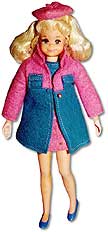 The first Skipper doll
was issued in 1964.
The first Skipper doll
was issued in 1964.
So did the lifestyle
of one American mother with a young daughter. The first, second and third
Barbie arrived in quick succession, spawning an addiction that lasted until
the little girl was grown and married. But the Barbies kept on arriving,
to satisfy the collecting instinct of the mother, for Barbie is an adult
doll, too and is collected as much by women as by girls.
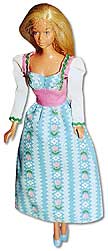 Twist
N Turn Barbie first appeared in 1966. Twist
N Turn Barbie first appeared in 1966.
Today, this private
collection is impressive. On three 4-foot shelves of her basement Barbie
shrine, 71 dolls are visible. There are other shelves and cabinets, a six-foot
long display case, plus more Barbies including the 18-inch Super Barbies
and the miniatures. Investors may salivate as they note Barbie’s cousin
Francie, a 1966 introduction as a blonde or brunette with bendable legs
now worth almost £300, or the original Twist N Turn Barbie valued
at more than £500?
Even this rarity
can be topped - by the 1968 speaking Barbie and her 'friend' Stacey, who
chatter on, saying: "What shall I wear to the prom?" "Would you like to
go shopping?" or "Stacey and I are having tea."
 Mod
Ken with long hair and polyester trousers was issued in 1972. Mod
Ken with long hair and polyester trousers was issued in 1972.
On average, your
best place to buy these luscious bits of make-believe is at auction. Most
dealers will deny this, but most of them buy at auction themselves. Consider
most auction prices as wholesale. That two-bidder scenario is only one
reason why some dolls appear to be worth more. The best and most frequent
reasons for price variation are, as with most other collectables, age condition
and scarcity.
It’s only common
sense that a doll in mint condition is worth more than one that has been
used, and frequently abused, or that a heavily-advertised doll backed up
by a huge production run will not be worth as much as one with limited
availability.
 Late
model Pink & Pretty Barbie issued in 1992. Late
model Pink & Pretty Barbie issued in 1992.
Other sources are
local newspapers, the Internet and dolls clubs. Check out antique shops,
toy shops, or write a letter to Mattel themselves. The public relations
department just may provide a few leads for Barbie-hunters.
Explosive demand
for Barbies caused prices to rise. One collectors price guide lists 886
Barbie dolls from 1959 to 1997, with prices ranging from £6 upward.
Many more Barbie related items are unknown and unlisted.
 Barbie’s
Dream House first appeared in 1975. Standing about 4 feet high and
almost 5 feet across, it comes complete with a working lift. Barbie’s
Dream House first appeared in 1975. Standing about 4 feet high and
almost 5 feet across, it comes complete with a working lift.
Uniqueness, can bring
great rewards. Barbie #1, an original from 1959 that fetched £2,760
at a Christies in London on July 22, yet high prices can have their own
drawbacks. Another one-of-a-kind – Diamond Barbie – created jointly by
Mattel and DeBeers to celebrate Barbie’s 40th anniversary – failed to sell
at the same auction. Dressed in a lustrous aquamarine gown studded with
160 diamonds weighing nearly 20 carats set in 18-carat gold, the doll carried
a pre-sale estimate of £20,000-£40,000 - evidently out of the
reach of Barbie fans.
|



